
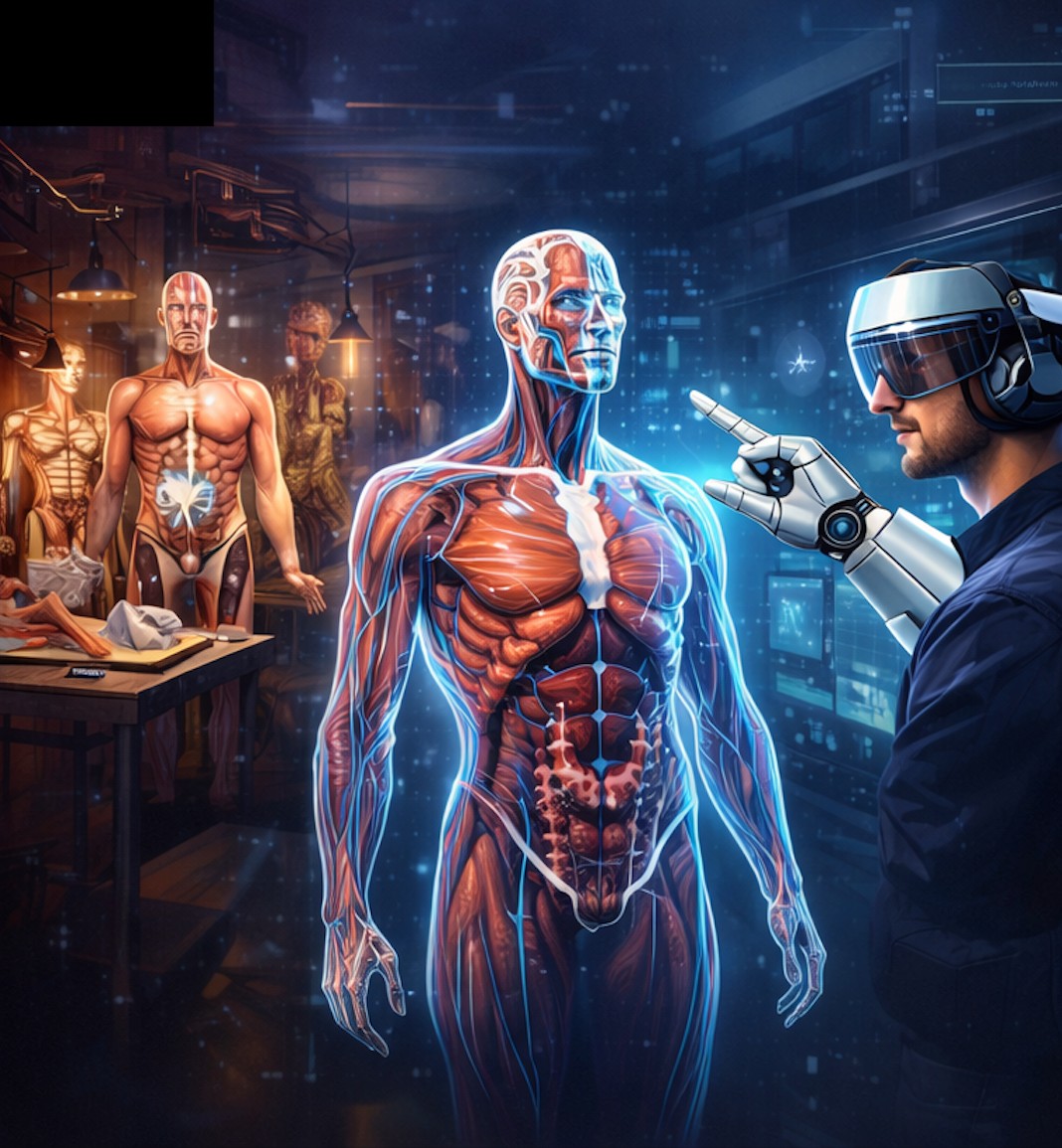
Anatomy teaching has long been the cornerstone of basic medical and health sciences education. With strong traditions in cadaveric dissection and clinical anatomy, it is now time to thoughtfully integrate artificial intelligence (AI) as a complementary educational tool. Rather than replacing traditional methods, AI in Anatomy Teaching enhances visualisation, personalisation, and clinical relevance, aligning with contemporary curriculum needs and student learning styles.
“AI is not a replacement for dissection, rather it is a powerful extension of how we teach and learn anatomy.”
Virtual and Digital Dissection Platforms
AI-powered virtual dissection platforms allow students to explore three-dimensional anatomical models with high fidelity. Tools such as Complete Anatomy (3D4Medical), Visible Body, and Sectra Education Suite use machine-assisted segmentation to display organs, vessels, and nerves in interactive layers. These platforms are particularly valuable for revision, pre-lab preparation, and remote learning; an important consideration for students across medical schools.
“Digital dissection enables students to revisit complex anatomy anytime, anywhere.”
AI-Driven Adaptive and Personalised Learning
AI enables adaptive learning by analysing student interactions and identifying areas of difficulty. For instance, platforms integrated with learning management systems such as Moodle can recommend targeted resources when students struggle with topics like neuroanatomy or abdominal vasculature. This personalised approach supports diverse learners and promotes equity by allowing students to learn at their own pace.
AI in Assessment and Feedback
AI-assisted assessment tools are increasingly used for virtual spot tests, image-based questions, and formative feedback. Automated marking and immediate feedback help students identify gaps early, while reducing staff workload. At medical schools, such tools can complement traditional practical assessments and vivas, maintaining academic rigor while improving efficiency.
Integration with Clinical Imaging and Practice
One of the most impactful uses of AI in anatomy teaching is its integration with clinical imaging. AI-enhanced platforms can align cadaveric anatomy with CT, MRI, and ultrasound datasets, helping students develop strong clinical and anatomical correlations. This is particularly relevant for vertically integrated curricula and early clinical exposure in medical education.
Conventional Dissection, Laparoscopic Anatomy, and the Role of AI
Conventional cadaveric dissection presents anatomy in an open, 3D and tactile manner. It allows learners to appreciate spatial relationships, tissue planes, and anatomical variation in their natural context. In contrast, laparoscopic anatomy is viewed through a camera-dependent, magnified, and often orientation-altered perspective. In laparoscopic anatomy, depth perception is limited and anatomical landmarks appear unfamiliar to novices. AI in Anatomy teaching helps to bridge this educational gap by enabling side-by-side comparison of open and laparoscopic views, overlaying annotated structures, and simulating camera angles and instrument trajectories. By integrating AI-assisted visualisation and image segmentation, students can better translate classical anatomical knowledge into minimally invasive and contemporary surgical practice.